
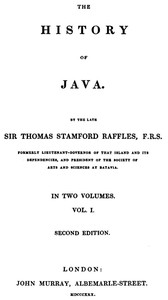
The History of Java, v. 1-2 by Sir Thomas Stamford Raffles
(4 User reviews)
1023
Raffles, Thomas Stamford, Sir, 1781-1826
English
"The History of Java" by Sir Thomas Stamford Raffles is a historical account written in the early 19th century. This seminal work details the geography, culture, and history of Java, an Indonesian island that was of great interest to European powers at the time. Importantly, it explores the consequences of colonialism and the interactions between t...
in this region. The opening of the account includes a dedication to the Prince Regent and a preface that establishes Raffles’ intent to provide an informed perspective on Java, while also addressing any potential misinterpretations regarding the Dutch administration. Raffles introduces the backdrop of his observations during his tenure as Lieutenant-Governor of Java, highlighting his motivations rooted in justice and benevolence towards the Javanese people. The introduction also outlines the geographical context of Java, its climatic conditions, and its notable historical significance in trade and colonial conquest by European powers, particularly emphasizing the early interactions of the Portuguese and Dutch. This sets the stage for a comprehensive exploration of Java's rich history, its people, and Raffles' reflections on colonial relations, which are likely to engage readers interested in history, anthropology, and colonial studies. (This is an automatically generated summary.)
Jennifer Nelson
3 months agoIt took me a while to start, but the explanations are structured in a clear and logical manner. I’ll be referencing this again soon.
Joseph Nelson
1 month agoFrom a reader’s standpoint, the material builds progressively without overwhelming the reader. I’d rate this higher if I could.
Donna Nelson
3 months agoAfter completing the first chapter, the author avoids unnecessary jargon, which is refreshing. A true masterpiece of its kind.
There are no comments for this eBook.



Steven Thompson
5 months agoI approached this with an open mind and the structure allows easy navigation and quick referencing. I’d rate this higher if I could.